
The “Impossible” Configuration: 3-Phase Power from a Single-Phase Grid
Case Study: Technical Specification by Energy Monkey | Installed by NB Electrical & Renewables
The Multi-Voltage Masterclass
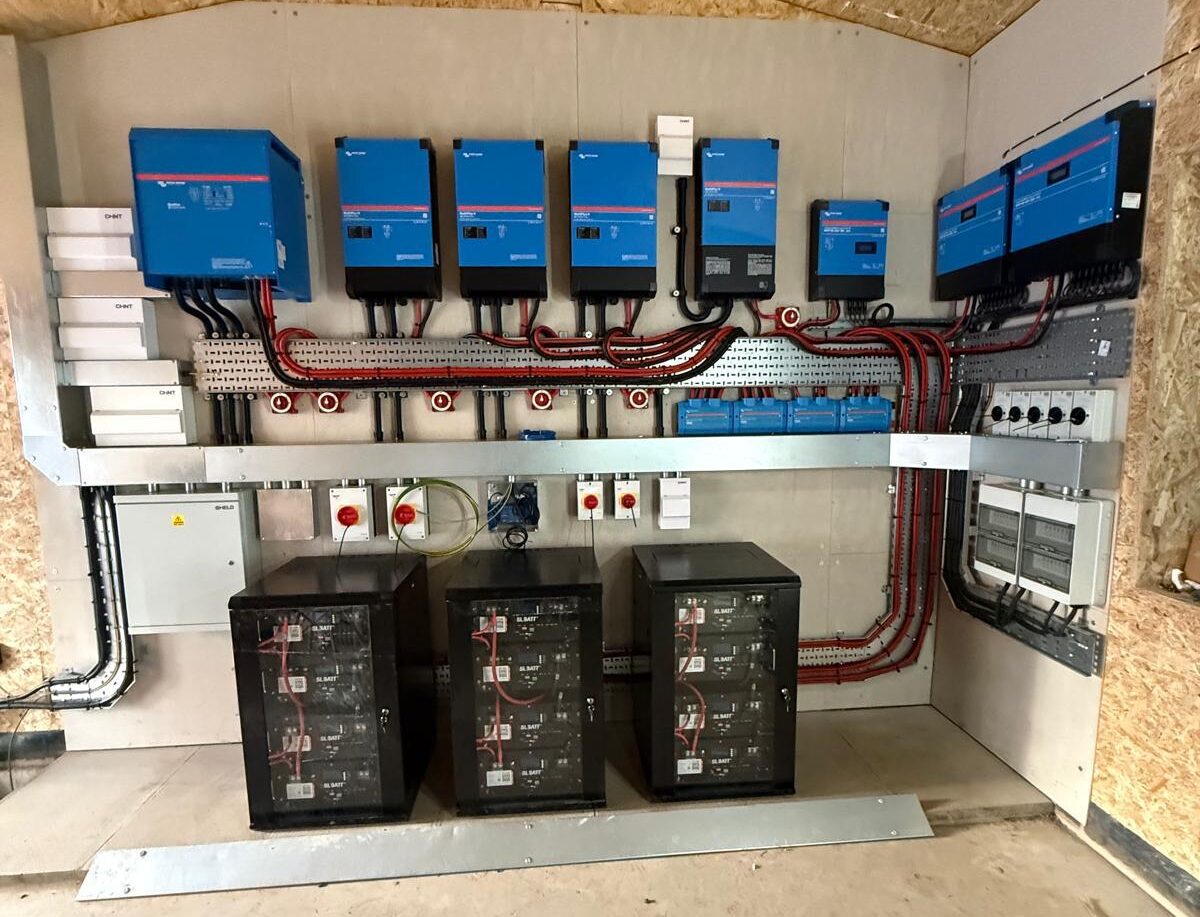
A monster system featuring Single-Phase 230V (15kVA), 3-Phase 415V (15kVA), and Single-Phase 120V (5kVA)—fulfilling every possible power need on a single residential site.
The Challenge: Three Systems, One Brain
When our Victron specialist installation partners at NB Electrical & Renewables came to us with a unique question—“Can we build a system with a 3-phase output and a specialist 120V output, powered purely by a single-phase grid supply?”—we were super excited to take on the challenge.
We have specified and commissioned numerous single-phase grid-connected installations using Victron inverter/chargers sharing a single battery bank. These setups solve massive headaches for clients who require significant power upgrades but face grid connection quotes costing tens (or hundreds) of thousands of pounds.
DNO Application Restrictions? No Problem.
Imagine building three independent power networks on a single site:
- 230V Single-Phase for the domestic dwelling (Grid-Tied ESS).
- 415V Three-Phase for industrial workshop machinery.
- 120V Single-Phase for specialist imported tools.
Running all three systems from a single managed battery bank requires meticulous planning, precise cable sizing, and a deep understanding of Victron’s VE.Bus and VE.Can communication protocols. The challenge wasn’t just making it work—it was making it work seamlessly so that a heavy workshop load never compromises backup power for the home.
The 3-Phase on Single-Phase Dilemma
Before diving into the hardware, let’s address the most common technical question in modern energy storage: “Can I create a 3-phase system from a single-phase supply?”
Creating 3-phase power from a single-phase grid isn’t as simple as linking three MultiPlus or Quattro units together and feeding single-phase power into L1.
Here’s why standard configurations fail:
- G99 Grid Compliance: To build a Victron ESS (Energy Storage System) in the UK, the system must run G99-compliant firmware. Standard G99 regulations require all internal anti-islanding relays across all phases to open simultaneously if a fault occurs on any single phase.
- The Relay Synchronization Rule: In a standard 3-phase Victron cluster, the internal relays must act in unison. The system requires a physical grid reference on all three phases (L1, L2, and L3) to synchronize. Without a physical voltage reference on L2 and L3, the system cannot “see” the grid correctly and will refuse to close its relays for safety.
- The Export Reality: You cannot export energy back to the utility grid on phases that do not physically exist at the meter.
The Design Solution: Topology Breakdown
To overcome these rules safely and legally, Energy Monkey designed a split architecture:
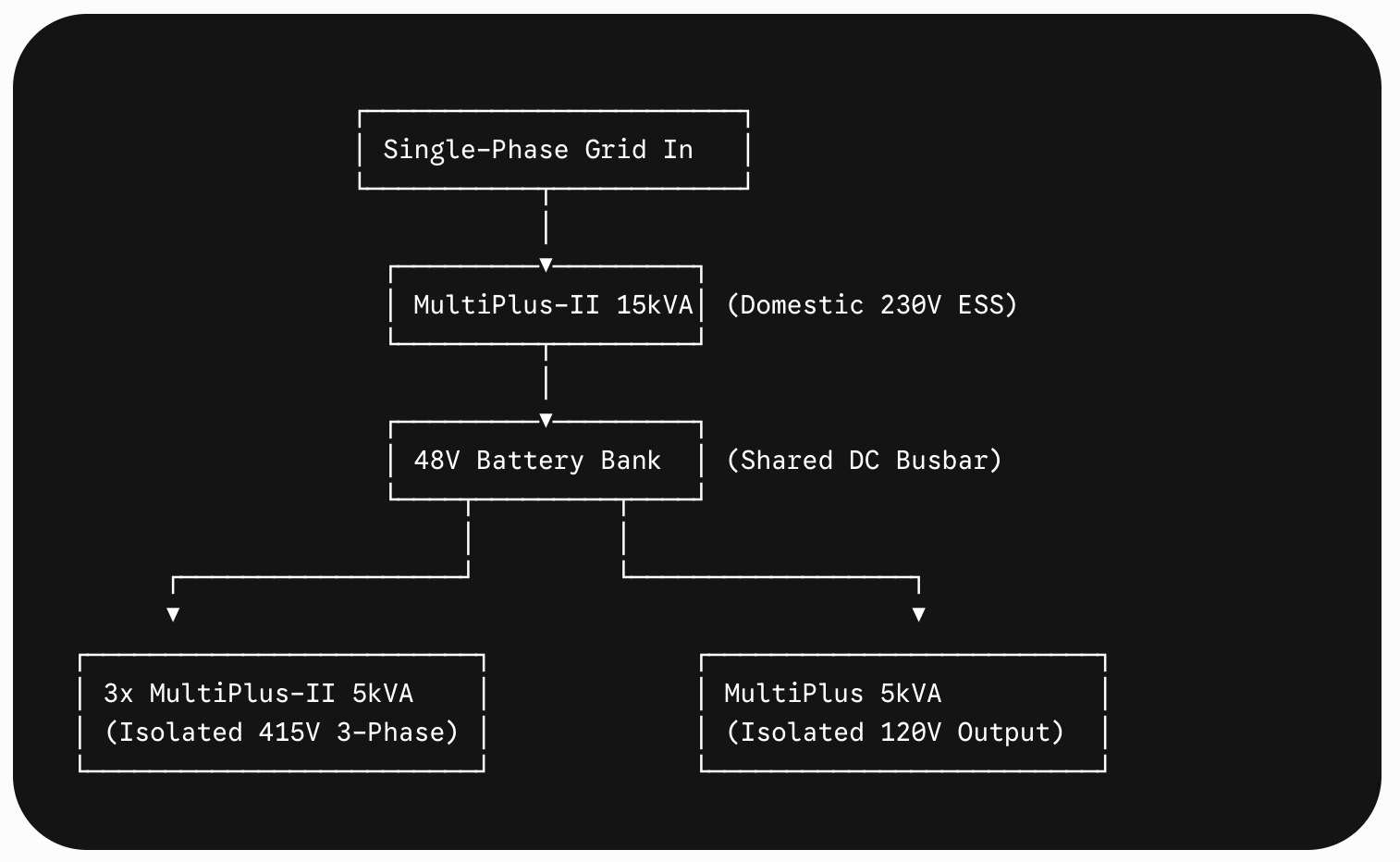
- Grid-Tied Domestic ESS: A single 15kVA Victron MultiPlus-II manages the home’s 230V loads, solar integration, and UK grid connection under strict G99 rules.
- Downstream DC-Coupled Microgrids: The 15kVA 3-Phase workshop cluster (3x 5kVA MultiPlus units) and the 5kVA 120V specialist loop run as independent, off-grid island topologies off the shared DC bus.
They draw power directly from the massive central battery bank but remain legally and technically decoupled from the utility grid interface.
The Solar Engine: High-Voltage Architecture
To fuel this massive energy requirement, we moved away from traditional lower-voltage charge controllers. The solar array consists of 80x Longi 475W All-Black panels, delivering a peak capacity of 38kWp.
Managing this solar power engine are:
- 2x Victron SmartSolar MPPT RS 450/200
- 1x Victron SmartSolar MPPT RS 450/100
Understanding Solar Clipping & Over-Panelling
Because the 38kWp solar array capacity deliberately exceeds the total maximum input capacity of the MPPT controllers (28.8kW), the system will experience “clipping” during absolute peak conditions:
- 2x RS 450/200: Max output of 23,040W
- 1x RS 450/100: Max output of 5,760W
- Total System Cap: 28,800W (28.8kW)
Why Over-Panel by 32%? This is an intentional design choice. Over-panelling ensures that during overcast days, early mornings, and late afternoons, the MPPTs operate near maximum capacity. On peak summer days, output clips at 28.8kW, but total daily energy harvesting is significantly higher year-round.
Expected Daily & Annual Yields (UK Climate)
Based on an average UK location (~2.8 Peak Sun Hours, factoring in system efficiency losses):
- Winter Day (Low Sun): 25 kWh – 40 kWh daily
- Summer Day (High Sun): 140 kWh – 170 kWh daily
- Expected Annual Generation: 30,000 kWh – 35,000 kWh
String Calculation & Temperature Coefficients
High-voltage array design requires precise mathematical verification. The Longi 475W panels have an Open Circuit Voltage (Voc) of 40.18V at standard test conditions (25°C).
However, silicon PV cells have a negative temperature coefficient of Voc—as outdoor temperatures drop during freezing winters (e.g., -10°C), string voltage rises significantly (to ≈ 43V per panel).
To protect the 450VDC maximum input limit on the Victron MPPT RS controllers:
- Absolute Max Series Limit: 9 panels per string (9 × 43V = 387V—leaving a comfortable safety margin).
- Our Perfect Layout: Across the 10 total available MPPT trackers (4 per RS 450/200, 2 for the RS 450/100), we specified 8 panels in series per tracker (8 × 10 = 80 panels). This runs the array at an ideal operational voltage of ≈ 265VDC per string, right in the sweet spot of Victron’s high-efficiency operating window.
High-voltage strings allowed NB Electrical to drastically simplify installation—reducing the need for heavy DC combiner boxes and enabling thinner, safer copper cable runs across the roof.
Battery Safety: BSLBatt & High-Current Distribution
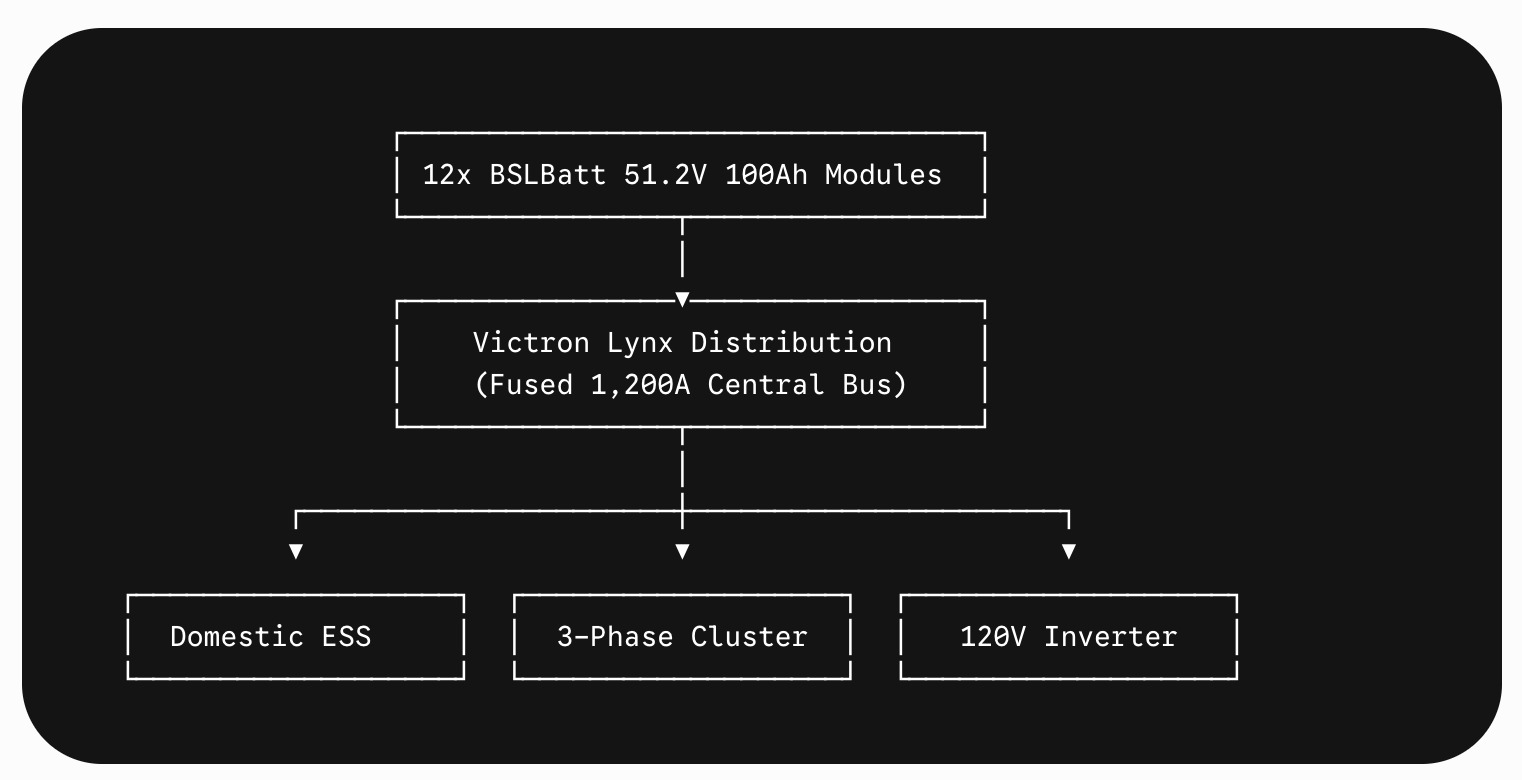
With 61.4kWh of storage on-site capable of delivering continuous currents up to 1,200 Amps into the shared DC busbar, battery safety and system protection were paramount.
We specified 12x BSLBatt 51.2V 100Ah rack modules, unified via Victron Lynx heavy-duty DC distribution busbars.
Why UL1973 and UL9540A Are Non-Negotiable
Not all lithium batteries are engineered equally. Cheaper imports rely on basic transport or regional self-declarations:
- UN 38.3: Proves only that a battery won’t catch fire while being bounced around in a shipping container.
- Basic CE Mark: Self-declared compliance without mandatory independent destruction testing.
For a residential install of this size, we selected BSLBatt for their rigorous third-party lab certifications:
The “Internal Fire Extinguisher” Advantage
Each BSLBatt module features an integrated Internal High-Temperature Aerosol Fire Suppression System. Should an internal fault occur, the module self-extinguishes before thermal runaway can spread to adjacent batteries.
Combine this physical protection with full VE.Can communication to the Victron Cerbo GX, and the system provides continuous cell-level monitoring across all 12 modules.
The Energy Monkey Standard
At Energy Monkey, we take pride in engineering power solutions that tackle real-world grid limitations head-on. This installation marks a major milestone: our first system engineered to simultaneously deliver 120V single-phase, 230V single-phase, and 415V three-phase power from a single-phase supply.
Through close partnership between Energy Monkey’s technical team and NB Electrical & Renewables’ top-tier installation work, we have proven that no power requirement is too complex for the Victron ecosystem.
Built-In Remote Management
Installing a system like this is only half the job—supporting it long-term is what matters. By integrating advanced remote monitoring via the Victron Cerbo GX & VRM Portal, Energy Monkey can perform full diagnostics, firmware adjustments, and operational checks remotely from anywhere in the world—ensuring years of uninterrupted performance for the client.
Got a complex grid connection or off-grid project? Speak to the technical design team at Energy Monkey today.
Contact Us
If you have any questions or need assistance in selecting the right kit for high profile installations like this, please don’t hesitate to reach out to us –
- 📞 Phone – +44 1452 699300
- ✉️ Email – info@energymonkey.co.uk
- 📍 Address – Unit 2 Huntley Business Park, Gloucester, GL19 3FF, United Kingdom
Stay Connected
Follow us on social media to stay updated on the latest products, news, and promotions –