

Latest News
BSLBatt vs Pylontech: Best UK Solar Battery Choice?
Feb
Comparing Solar Battery Prices Across Brands
Watching your electricity bill climb higher every month is frustrating. You’ve heard that a solar battery can help you take back control, storing free energy from the sun to use whenever you want. But when you start looking, you’re faced with a confusing choice, and it’s tempting to grab what seems like a great deal.
For years, Pylontech has been a go-to budget option, making it a familiar name. However, a newer player, BSLBatt, is rapidly gaining ground with UK installers, forcing homeowners to ask a crucial question. Is Pylontech the cheapest battery actually the most cost effective solar battery solution for your money in the long run?
The answer isn’t on the price tag; it’s hidden in how the battery performs over its entire life. Think of it like buying shoes: a cheap pair saves you money today but wears out in a few months, whereas a durable, more expensive pair lasts for years, offering far better value. Finding the best home battery storage UK requires looking beyond that initial cost to understand what you’re truly getting.
This guide breaks down the essential differences in the BSLBatt vs Pylontech debate, giving you a simple framework to calculate the true, long-term value of any battery. You’ll learn the key questions you must ask your installer before you buy, enabling you to confidently choose a battery that saves you the most money over the next decade, not just on day one.
What is a Battery’s ‘Capacity’ (kWh) and Why Isn’t it Everything?
When you first explore residential energy storage in the UK, the main number you’ll see is “capacity,” measured in kilowatt-hours (kWh). This is simply the unit we use to measure how much electricity a home battery can hold. The easiest way to understand this is to think of it like a fuel tank for your house. A 5kWh battery is a 5-litre tank for your electricity, while a 10kWh battery is a 10-litre tank. It tells you how much energy you can draw on before it’s empty.
To put that number into perspective, consider what it can actually power. A modern dishwasher uses about 1 kWh for a full cycle. Therefore, a fully charged 5kWh battery could run your dishwasher five times. It could also keep an average fridge-freezer running for about 13 days, or power your TV and lights for a solid 60 hours straight. This kilowatt-hour explained figure helps you visualise how much of your daily life can be powered by your stored solar energy or off-peak grid electricity.
However, this is where many people make a costly assumption: that bigger capacity automatically means better value. Think about it this way—a huge fuel tank isn’t very useful if the engine can only access half the fuel inside, or if the tank itself starts to degrade after just a few years. Some batteries, despite boasting a large kWh number, may not let you use all of their stored energy or might wear out much faster than others.
Ultimately, choosing a battery based on capacity alone is like buying a car based only on the size of its fuel tank. It gives you a starting point, but it tells you nothing about the car’s real-world efficiency or how long the engine will last. The initial capacity tells you how much energy a battery can store today, but it doesn’t reveal the total amount of energy it will deliver over its lifetime—which is the key to getting a true return on your investment.
The First Hidden Metric: Understanding the difference between 48V (15 cells) and 51.2V (16 cells)
In the world of solar energy storage, most batteries are broadly categorized as “48V.” However, if you look closely at the spec sheets of industry giants like Pylontech and BSLBATT, you’ll notice a subtle but profound difference in their nominal voltage.
Pylontech (specifically the US2000/US3000/US5000 series) typically operates at 48V (15 cells), while BSLBATT and most modern “Server Rack” batteries operate at 51.2V (16 cells). This single extra cell is the “hidden metric” that changes everything from inverter efficiency to the lifespan of your system.
1. The Chemistry Math: 15s vs. 16s
Lithium Iron Phosphate (LiFePO4) cells have a nominal voltage of 3.2V. The “48V” label is often just a legacy term carried over from lead-acid systems. The actual voltage is determined by how many of these cells are stacked in series (indicated by the ‘s’ rating).
+1
| Feature | Pylontech (Standard) | BSLBATT (Standard) |
|---|---|---|
| Cell Configuration | 15 Cells in Series (15s) | 16 Cells in Series (16s) |
| Nominal Voltage | 48v | 51.2v |
| Full Charge Voltage | 52V | 55V |
| Discharge Cut-off | 42V | 44.8V – 48.0V (Adjustable) |
2. Advantages of the 16-Cell (51.2V) Architecture
Choosing a 51.2V system like BSLBATT over a 15-cell system offers several technical “unfair advantages”:
- Higher Energy Density: For the same 100Ah capacity, a 16-cell battery provides more total energy.
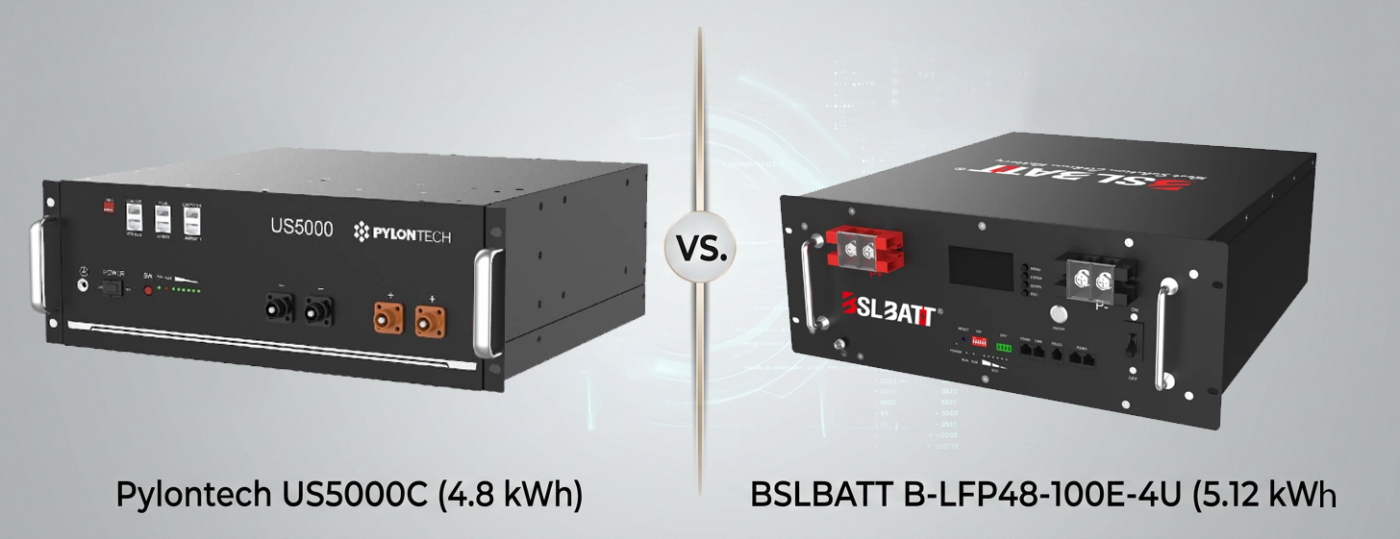
- 15 cells: x 3.2v x 100Ah = 4.8kWh
- 16 cells: x 3.2v x 100Ah = 5.12kWh
- Result: You get 6.6% more usable energy in the same physical footprint.
- Increased Inverter Efficiency: Most modern hybrid inverters (Victron, Sunsynk, Solis, Deye) are optimized for a 50V–60V DC range. A 51.2V battery stays within the inverter’s “sweet spot” for longer, reducing conversion losses and heat.
- Lower Current, Less Heat: To deliver 5,000W of power:
- A 48V battery must pull 104.1 Amps.
- A 51.2V battery only pulls 97.6 Amps.
- Benefit: Lower amperage means less stress on cables, less heat generation, and a lower risk of tripping breakers during peak loads.
- Better Compatibility with Lead-Acid Legacy: 16-cell lithium batteries almost perfectly mimic the voltage curve of a traditional 48V lead-acid bank. This makes them easier to “drop in” to older systems without the inverter thinking the battery is “empty” when it still has 20% charge left.
3. Why Pylontech uses 15 Cells
If 16 cells are technically superior, why does Pylontech use 15?
- Safety Margins: By using 15 cells, Pylontech keeps the maximum charge voltage lower (54V), ensuring they never exceed the “Extra Low Voltage” safety thresholds of certain older international regulations.
- Lower Cost: Pylontech are able to offer a lower price point with 1 less cell making there products appear much more attractive from a cost standpoint.
- Legacy Standardization: Pylontech was one of the first movers in the market. They established a standard when many early inverters had narrow voltage windows.
Summary: Which should you choose?
While Pylontech is a world-class brand known widely around the world by solar installers as a low cost solution that is compatible with many major inverter brands. BSLBATT’s 51.2V (16-cell) architecture is the more modern, efficient standard with many superior features such as inbuilt Fire Suppression and Cloud Capability.
If you are looking for the maximum “bang for your buck” in terms of raw energy storage and system efficiency, the 16-cell configuration is the clear winner. It works cooler, lasts longer under heavy load, and provides more kilowatt-hours for every Amp-hour you buy.
The Second Hidden Metric: Lithium is not all the same
When comparing BSLBATT and Pylontech, you aren’t just comparing brands; you are comparing two fundamentally different ways of building a battery.
While both use Lithium Iron Phosphate (LiFePO4) chemistry, the physical form factor of the cells inside—Prismatic (BSLBATT) versus Pouch/Lithium-Ion Polymer (Pylontech)—determines how the battery handles heat, physical stress, and long-term aging.
1. The Anatomy of the Cell
The design of the cell acts as the first line of defense and the primary engine for performance.
- BSLBATT (Prismatic Cells): These are large, rectangular cells encased in a rigid aluminum or steel shell. They are essentially “solid blocks” of power.
- Pylontech (Pouch/Polymer Cells): These cells use a flexible aluminum-plastic film (laminated foil) instead of a hard shell. They resemble a vacuum-sealed silver bag.
| Feature | BSLBATT (Prismatic) | Pylontech (Pouch) |
|---|---|---|
| Outer Casing | Rigid Metal (Hard-shell) | Flexible Foil (Soft-shell) |
| Mechanical Strength | Very High | Low (Requires external support) |
| Weight | Heavier (Due to metal casing) | Lighter (Higher energy density) |
| Internal Structure | Stacked or Wound sheets | Laminated/Stacked layers |
2. The Benefits of BSLBATT’s Prismatic Design
Prismatic cells are widely considered the industrial standard for stationary energy storage (homes and businesses) for several reasons:
- Superior Durability: The rigid metal casing protects the internal chemistry from external impacts, vibrations, and accidental punctures. In a stationary home environment, this provides a “tank-like” level of protection.
- Mechanical Compression: LiFePO4 chemistry naturally expands and contracts during charge cycles. Prismatic cells are designed to be bolted together under pressure, which prevents the internal layers from delaminating. This mechanical stability is a key reason why they often achieve 6,000+ cycles.
- Heat Dissipation: Metal is an excellent conductor of heat. The large, flat surface area of a prismatic cell allows for efficient cooling, ensuring that the center of the battery pack doesn’t develop “hot spots” that shorten its life.
3. The Pylontech “Pouch” Approach
Pylontech uses pouch cells (often referred to as Lithium-Ion Polymer because of the laminated packaging). While these are highly sophisticated, they have different characteristics:
- The Weight Advantage: By removing the heavy metal casing, Pylontech batteries are much lighter and easier to wall-mount or install by a single person.
- Safety via “Venting”: If a pouch cell fails or builds up gas, the soft foil simply swells up or ruptures at a seam. Because it isn’t a sealed “metal pressure cooker,” it is less likely to explode violently; it simply “off-gasses.”
- The Swelling Risk: The biggest downside to pouch cells is swelling. Over years of use, microscopic gas buildup can cause the “pouches” to expand. If the battery casing doesn’t account for this, it can put pressure on the BMS or other cells.
4. Which is better for Solar Storage?
For a home solar system, BSLBATT’s Prismatic cells generally offer a slight edge in “industrial longevity.”
- Pylontech is the “Consumer Tech” approach: Lightweight, incredibly easy to install, and works with many brands and low cost.
- BSLBATT is the “Industrial” approach: Heavy-duty, high-strength, and built to withstand the mechanical stresses of high-power charging/discharging over 15–20 years.
Summary Table: Prismatic vs. Pouch
| Benefit | Prismatic (BSLBATT) | Pouch (Pylontech) |
|---|---|---|
| Cycle Life | Higher (due to better compression) | Moderate to High |
| Physical Safety | Metal shell prevents punctures | Soft shell is safer during gas buildup |
| Heat Management | Excellent (Metal casing) | Good (Thin profile) |
| Ease of Install | Heavier/Bulkier | Lighter/Slimmer |
The Second Hidden Metric: Why ‘Cycle Life’ Determines Your Battery’s Real Lifespan
While capacity (kWh) is a starting point, the first hidden metric that reveals a battery’s true quality is cycle life. Think about your smartphone. You know that after a few years of charging it every night, the battery doesn’t hold its charge as well as it used to. Each of those charge-ups is a “cycle.” A home battery works the same way. Its cycle life is the total number of full charge and discharge cycles it can handle before its performance significantly drops. It’s a direct measure of how long the battery is built to last.
This single number can be the difference between a battery that serves you for a decade and one that could last for two. When you review the manufacturer’s specifications, you’ll see a guaranteed minimum number of cycles. This is where the contrast between a budget option like Pylontech and a value-focused brand like BSLBatt becomes crystal clear. A quick BSLBatt lithium battery review UK installers often point out is its superior endurance.
- Pylontech (US2000C, US3000C, US5000C & UP2500): Advertise cycles for around 6,000 cycles.
- BSLBatt (51.2v 100Ah Rack): Guaranteed for over 8,000 cycles.
That difference of 2,000 cycles might not sound like much, but it’s enormous. If you cycle your battery once per day—a typical scenario for a home with solar panels—a Pylontech battery is should last for just over 16 years. The BSLBatt, on the other hand, is built to last for nearly 22 years. This is one of the key reasons some users report long-term Pylontech battery lifespan issues; the product is simply designed for a shorter operational life compared to more robust competitors.
Ultimately, a higher cycle life means you’re buying a product that will keep delivering value for many more years, but many manufacturers often fall into the promise of more cycles, lower cost and longer warranty and in reality this is not really realistic to achieve everything as higher quality is never cheap and long warranty and support is never free.
The other half is about how much energy you can actually use in each of those cycles, if you stress your batteries less and discharge them less they will last longer simple.
The Third Hidden Metric: “Depth of Discharge” (DoD) and The Energy You Can Actually Use
Understanding a battery’s cycle life is only half the battle. To find the true value of your investment, you need to know how much of that energy you are actually allowed to use day-to-day. This brings us to the next “hidden metric”: Depth of Discharge (DoD).
Think of your battery like a car’s fuel tank. Even when your gas gauge hits “Empty,” there is a small reserve left in the tank. This is a safety buffer designed by the manufacturer to protect the fuel pump. In the world of Lithium Iron Phosphate (LiFePO4), this buffer is critical for chemical longevity.
The Reality of the “Safety Buffer”
It is a common misconception that high-end batteries allow you to use 100% of their chemical capacity. In reality, all lithium batteries require a “headroom” and “footroom” buffer to survive for 10+ years.
- The Top (Charge): No lithium battery likes to be pushed to its absolute chemical ceiling. Manufacturers typically limit the maximum charge voltage (e.g., to 54V-56V) to prevent cell stress and “swelling.”
- The Bottom (Discharge): If a battery is left at 0% for too long, the voltage can drop below a critical point, causing permanent damage. To prevent this “bricking,” the BMS (Battery Management System) will shut the battery down while a small amount of energy remains.
Pylontech vs. BSLBATT: A Similar Philosophy
Contrary to some marketing claims of “100% DoD,” both Pylontech and BSLBATT utilize a conservative software-managed approach to protect your investment.
| Feature | Pylontech (US5000C) | BSLBATT (B-LFP48-100E) |
|---|---|---|
| Total (Nominal) Capacity | 4.80 kWh | 5.12 kWh |
| Standard Recommended DoD | 95% | 80% – 95% (Configurable) |
| Usable Energy | 4.56 kWh | 4.10 – 4.86 kWh |
Technical Correction: While BSLBATT’s 16-cell architecture provides a slightly higher total energy starting point (5.12kWh vs 4.8kWh), they do not recommend discharging to a “true” 100% of the cells’ capacity. Like Pylontech, they use a managed buffer—typically recommending an 80% to 90% DoD for those wanting to reach the 6,000+ cycle mark.
Why the “Usable” Number Matters More Than the “Nominal”
When you see a battery marketed as 5kWh, you are often paying for a “5-liter bucket” that the software will only let you fill with 4.5 liters of water.
- Life Extension: By raising the “floor” (stopping discharge at 10% instead of 0%), the manufacturer significantly reduces the chemical stress on the prismatic cells.
- Safety Margin: This reserve ensures that if you have a power outage and the battery hits “0%,” there is enough energy left to keep the BMS (the battery’s brain) alive for several weeks until the sun comes back up.
- The Math of Value: When comparing these two brands, the “performance gap” isn’t about one being “unlocked” and the other “locked.” It is about the Total Usable Energy.
- Because the BSLBATT starts with more cells (16 vs 15), even at a conservative 90% DoD, it still delivers 4.6kWh—more than the Pylontech delivers at its maximum 95% DoD.
Summary: The Balanced Approach
Both Pylontech and BSLBATT have moved toward a 95% usable capacity standard in their latest models (like the US5000C and the BSLBatt B-LFP48-100E-4U or the BSLBatt PowerLine series). This represents the modern “sweet spot” of engineering: giving you the maximum possible energy without sacrificing the 10-to-15-year lifespan you expect.
When choosing between them, don’t look for “100% DoD”—look for the battery that gives you the highest Usable kWh per Dollar, knowing that the “missing” 5% is actually an insurance policy for your battery’s health.
The Fourth Metric: Warranty Realities and the Pylontech “Claim Barrier”
When you invest in a battery, a 10-year warranty certificate feels like a safety net. However, the value of that piece of paper is entirely dependent on the manufacturer’s claim process. While Pylontech and BSLBATT both offer industry-standard 10-year warranties, the experience of actually using them differs significantly.
1. Warranty Specifications Comparison
| Feature | Pylontech (Standard) | BSLBATT (Standard) |
|---|---|---|
| Duration | 10 Years (7 standard + 3 after registration) | 10 Years (Standard) |
| Cycle Guarantee | ~6,000 Cycles | ~6,000 Cycles |
| End-of-Life Capacity | Often 60% – 70% | Typically 70% |
| Throughput Limit | Varies by model (e.g., US5000C approx. 15MWh) | Often based on cycles (e.g., 30MWh+) |
2. Known Issues: The Pylontech “Log Barrier”
Pylontech is a global leader, but in recent years, users and installers have reported that claiming a warranty can be a technically demanding and frustrating process. If a Pylontech battery fails, “just calling the shop” is rarely enough.
- The Mandatory Log Requirement: Pylontech requires internal BMS data logs to even consider a claim. This isn’t just a simple screenshot; you often need a specific “Console to USB” cable and proprietary software (Battery View) to extract the history. If you are a DIY user without this cable or technical knowledge, your claim may be dead on arrival.
- The “Six-Month Rule”: Pylontech’s warranty explicitly states that batteries must be recharged to at least 90% every six months during storage. If your system was switched off during a house renovation or for winter storage and a cell fails, Pylontech can use the internal logs to prove you didn’t maintain it, potentially voiding the warranty.
- Installation Scrutiny: Pylontech has become much stricter regarding certified installers. Claims have been denied because the battery was installed by the homeowner rather than a registered professional, or because the specific cable lengths/types didn’t meet their exact manual specifications.
- Verification Latency: Because Pylontech is a massive corporation, claims often go through several layers of distributors before reaching the manufacturer. This can lead to “log fatigue,” where you are asked for the same data repeatedly while your house stays in the dark.
3. The BSLBATT Warranty Experience
BSLBATT operates with a more “Industrial” support model, which has its own pros and cons:
- Direct Local Support: In many regions (UK, South Africa, USA), BSLBATT works through specialized local distributors who have the authority to swap units faster than Pylontech’s global chain.
- Prismatic Stability: Because BSLBATT uses heavy-duty prismatic cells, they are physically more resilient to “swelling”—a common issue that triggers warranty claims in Pylontech’s pouch-cell designs.
- Simpler Reporting: While they still require data, BSLBATT systems are often more transparent with their BMS data via the inverter interface (Victron or Sunsynk), making it easier to prove a cell failure without needing specialized “hacking” cables.
- BSLBATT have many easier options for remote support with their Cloud so dealers and tech support can remotely diagnose issues before the customer needs to send the battery back.
Summary: Paper vs. Practice
- Pylontech is a “high-tech” warranty. It is iron-clad if you have perfect logs, a professional installer’s signature, and have followed every maintenance rule to the letter.
- BSLBATT is a “heavy-duty” warranty. The rigid prismatic construction means you are less likely to need the warranty in the first place, and local distributor networks often make the replacement process more human and less bureaucratic.
The ‘Aha!’ Moment: How to Calculate the True Cost of a Home Battery
We’ve covered cycle life and the usable energy you get from Depth of Discharge. By combining these, we can answer the most important question for any homeowner: what is the true cost of a home battery? The price you see on the invoice is only the beginning of the story. The real value lies in how much energy the battery will give you for every pound you spend over its entire lifespan. This is the key to finding a cost-effective solar battery solution.
It’s a simple idea when you think about it. Imagine buying a cheap, unbranded phone charger for £5 that breaks after six months. You then buy a £15 official one that lasts for three years. The “cheaper” option actually cost you more in the long run. To avoid this with a major investment like a battery, we can do some simple maths to find the “cost per unit of energy,” which is measured in kilowatt-hours (kWh).
Here’s the straightforward, three-step formula to calculate the lifetime cost of any battery. This is the secret installers use to compare models behind the scenes:
- Calculate Usable Energy: Multiply the battery’s advertised capacity (kWh) by its Depth of Discharge (DoD) percentage. This tells you how much energy you can actually use with each cycle.
- Find Total Lifetime Energy: Multiply your Usable Energy (from Step 1) by the battery’s total cycle life. This reveals the total amount of energy the battery is guaranteed to deliver before it needs replacing.
- Discover the True Cost per kWh: Divide the battery’s upfront price (£) by its Total Lifetime Energy (from Step 2).
Let’s put this into practice and run the numbers for a typical Pylontech vs BSLBatt comparison.
In our example, the Pylontech US5000C costs £800 with a 6,000-cycle life. The BSLBatt costs more upfront at £1000 but offers an 8,000-cycle life. We will calculate both batteries at 90% usable energy.
- Pylontech:
- Lifetime Energy: (4.8kWh x 0.90 DoD) x 6,000 cycles = 25,920 kWh
- True Cost: £800 ÷ 25,920 kWh = 0.03p per kWh
- BSLBatt:
- Lifetime Energy: (5.12kWh x 0.90 DoD) x 8,000 cycles = 36,864 kWh
- True Cost: £1000 ÷ 36,864 kWh = 0.02p per kWh
The results are are small but amazon clear. Even though the BSLBatt battery had a higher initial price, the energy it produces over its lifetime is significantly cheaper. You get more power and better value for every pound spent. This calculation reveals a manufacturer’s true confidence in its product, but there’s another, even more direct clue to a battery’s quality and expected lifespan.
Why a 10-Year Warranty is Your Best Clue to a Battery’s Quality
Beyond all the calculations, the manufacturer’s warranty is the simplest and most direct signal of their confidence. Think about any major purchase, from a car to a television—a long warranty is a promise that the company expects its product to last. In the world of home battery storage UK, a 10-year warranty has become the gold standard, indicating a battery is built for the long haul. It tells you the manufacturer is prepared to stand behind its product for a full decade of service.
This is where another key difference between the two brands emerges. A BSLBatt battery warranty and support package is straightforward: you get a 10-year guarantee as standard. For years, the popular Pylontech models came with a shorter standard warranty, requiring homeowners or their installers to register the product online to extend it to a longer period. While an extension is possible, the out-of-the-box promise from BSLBatt is simply longer, removing an extra step and potential pitfall for the customer.
This difference becomes critical when you consider the financial risk. Imagine your battery fails in its seventh year. If it’s only covered by a five or seven-year warranty, you’re left with a bill for a brand-new unit, instantly wiping out years of electricity savings. These potential Pylontech battery lifespan issues, especially after a shorter warranty expires, are what lead many to question, “Is Pylontech a good battery for my peace of mind?” The risk falls squarely on your shoulders once the guarantee period is over.
Ultimately, a strong, ten-year warranty is more than just a piece of paper; it’s a financial safety net. It demonstrates the manufacturer has faith in its cycle life claims and is willing to bet its own money on the battery’s performance. This growing demand for long-term reliability and hassle-free support is a major reason why the UK market is beginning to shift, with more installers reconsidering their go-to recommendations.
The UK Market Shift: Why More Installers are Recommending BSLBatt
When you hire a good mechanic, you trust their choice of spark plugs. You don’t expect them to use a cheap part that might fail and force you to come back a month later. The same logic applies to solar installers. These are professionals who work with different batteries every single day, and their recommendations are one of the most powerful clues you can get about a product’s real-world quality. They see firsthand which batteries perform reliably year after year and which ones cause problems. Their opinion is a practical BSLBatt lithium battery review UK in itself, based on hands-on experience rather than just marketing promises.
For an installer, their reputation is everything. A battery that fails prematurely leads to angry customer calls, unpaid return visits, and hours spent on warranty claims. This is why many professionals are looking beyond the initial price tag. From their perspective, a slightly higher upfront cost for a dependable battery is a small price to pay for peace of mind—both for their customer and their own business. The question of why choose BSLBatt over Pylontech is often answered by an installer’s need to avoid the hidden costs of an unreliable product, which can damage their reputation and increase their operational UK solar battery installation costs.
This focus on long-term reliability is causing a noticeable shift in the industry. Installers who once defaulted to cheaper options are now increasingly recommending BSLBatt for its robust performance and hassle-free, 10-year warranty. They see it as a “fit and forget” solution that delivers on its promises, ensuring a happy customer for the next decade. This growing professional trust is the key reason many now see BSLBatt as the new leader in the UK lithium battery market.
So, is Pylontech a Bad Battery? When Cheaper Might Be an Option
This focus on long-term value raises a fair question: is Pylontech a good battery at all? The straightforward answer is yes, but for specific situations. Its popularity isn’t an accident; for years, it has been the undisputed king of low upfront cost, making home energy storage accessible to thousands of people who might have otherwise been priced out of the market entirely. Pylontech succeeded by being “good enough” for the price, a strategy that many consumer electronics brands use.
So, when does “good enough” make sense? Imagine you have a workshop or a holiday cabin with very light energy needs. You might only use it on weekends or for a few weeks a year. In this scenario, you won’t be cycling the battery daily, so its total lifespan (the number of times it can be charged and drained) is far less critical. Paying a premium for a battery that will last 8,000 cycles is unnecessary if you’ll only use 1,000 cycles over the entire time you own the property. Here, the lower initial price of Pylontech can be the most sensible choice.
Another key factor is how long you plan to stay in your home. If you think you might move in the next three to five years, investing in a top-tier battery designed to last for fifteen years doesn’t make financial sense—you won’t be there to see the return on that investment. For short-term homeowners, a more basic, cost effective solar battery like Pylontech can cover your needs without over-investing in a feature (extreme longevity) you simply won’t use. This is also a reason it’s sometimes considered for simple off grid living setups where the initial budget is the biggest hurdle.
Ultimately, the choice comes down to matching the tool to the job. While Pylontech can be a smart buy in these niche cases, most UK homeowners installing solar are looking for a long-term solution to combat rising energy bills for the next decade or more. For them, exploring Pylontech battery alternatives like BSLBatt is crucial to ensure their investment pays off year after year. To figure out which camp you fall into, you need to ask the right questions before you buy.
Your 5-Question Checklist Before Buying Any Solar Battery
Navigating the world of home energy storage can feel overwhelming, especially when you’re speaking with a sales professional. To cut through the noise and ensure you’re making a smart investment, you need to be in control of the conversation. This simple checklist is designed to do just that. By asking these five direct questions, you can quickly compare any two batteries—whether it’s a BSLBatt vs Pylontech battery comparison or another brand entirely—and discover the true value beyond the price tag. This list is the most powerful tool you have to determine the best home battery storage UK for your family’s needs.
Here is exactly what to ask solar installer to get the clarity you need:
- What is the final upfront cost, including the battery, all necessary parts, and the full installation?
- What is the battery’s total capacity in kilowatt-hours (kWh), and what is its guaranteed Depth of Discharge (DoD)?
- What is the guaranteed cycle life of the battery, and how many years does the performance warranty cover?
- Based on those numbers, can you show me the calculated lifetime cost per kWh for this unit?
- Why do you recommend this specific brand for my home over the alternatives?
Armed with the answers to these questions, you’ll be able to see past the marketing and easily identify which option offers genuine, long-term savings. You’re no longer just buying a battery; you’re making an informed financial decision about your home’s energy future.
Making the Smart Choice: Investing in a Decade of Energy Security
You can now look at a home battery and see what truly matters. You have the knowledge to look past the initial cost and ask the critical questions about long-term value. This new ability means you can confidently evaluate any option, from established budget choices to strong Pylontech battery alternatives like BSLBatt, and understand exactly what you’re paying for.
Your first step isn’t to pick a brand, but to change the conversation with your installer. When you get a quote, ask them: “What is the cost per kilowatt-hour over the battery’s entire lifetime?” Remember that the answer is hidden in the cycle life, the usable energy (DoD), and the length of the warranty. This single question is the key to making a smart investment that will maximize the benefit of your renewable power sources.
Choosing the right battery is more than a technical decision; it’s an investment in your family’s financial security and energy independence. By looking past the price, you’re not just buying a piece of equipment. You are choosing a decade of lower bills, predictable power, and the peace of mind that comes from securing your home’s energy future.
Still need help with your choice?
You can now contact us at Energy Monkey via email info@energymonkey.co.uk or telephone 01452 699300 we have huge experience with building systems of all sizes for both Pylontech and BSLBatt and would be happy to discuss your requirements. We also have a range of pre configured kits to fit most applications on our website for Off-Grid Residential Grid Connected and Commercial. If you require anything bigger please contact us as we would design a bespoke solution for you.